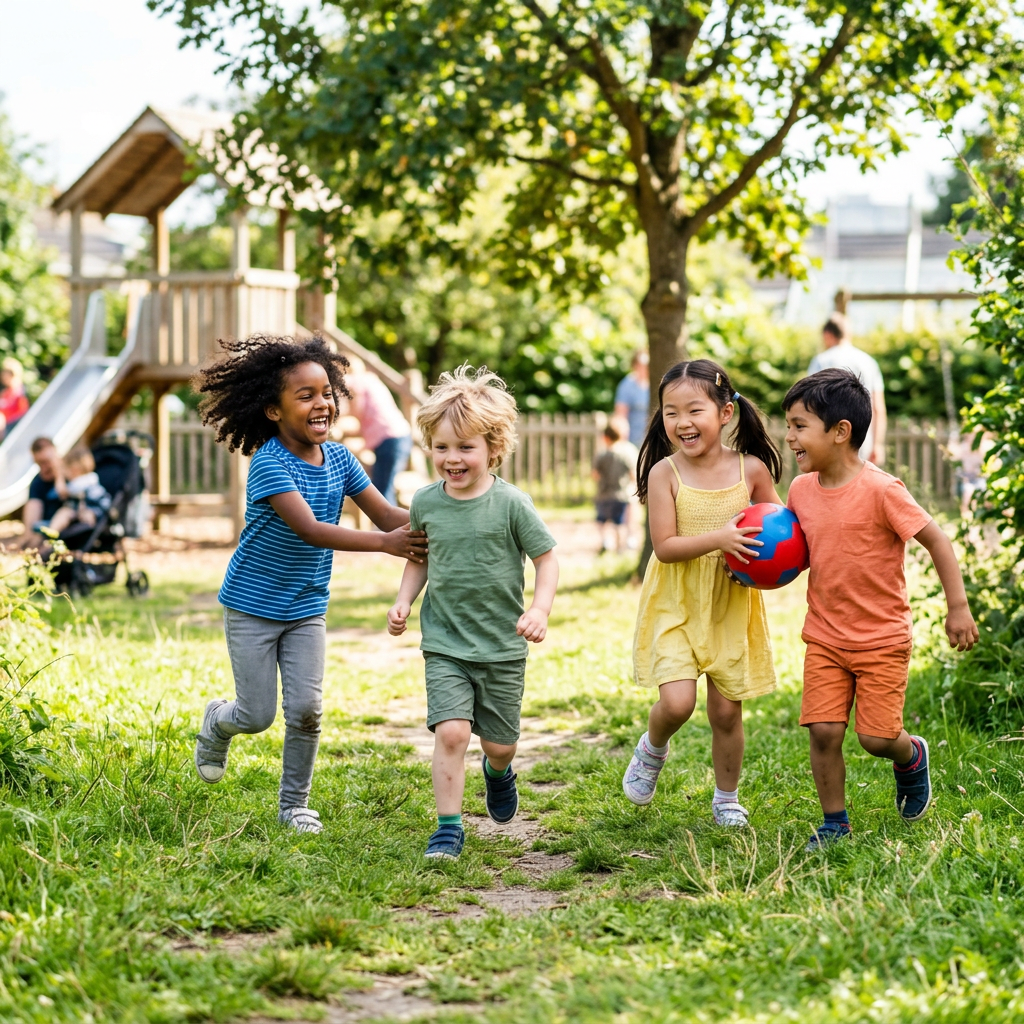
In recent years, opportunities for children’s play have become increasingly limited. In many schools, physical education receives less emphasis and is sometimes even withheld as a consequence for classroom behaviour. At the same time, children are spending more time indoors using tablets and phones rather than engaging in outdoor play. Broader social and economic pressures also affect opportunities for free play, as many families rely on two working parents due to the rising cost of living, while limited childcare spaces can restrict access to environments that support play. In addition, concerns about safety, injury, and liability may lead parents and caregivers to limit children’s play experiences. Together, these factors highlight why play must be recognized and protected as an essential part of early childhood development.
Literature Review: The Importance of Play in Early Childhood
Play is widely recognized in early childhood research as a central mechanism through which children develop cognitive, social, emotional, physical, and early academic competencies. Rather than functioning as a break from learning, play is consistently described as one of the main ways young children explore their environment, build relationships, and practice emerging skills in developmentally appropriate ways. This literature review synthesizes key themes from recent professional and research-based sources on the importance of play in early childhood (Head Start Early Childhood Learning and Knowledge Center, 2024).
Cognitive and Academic Development
The literature strongly supports the role of play in cognitive development. Head Start Early Childhood Learning and Knowledge Center (2024) notes that play benefits every aspect of child development and promotes exploration, curiosity, problem-solving, memory, and critical thinking. ChildCare.gov (n.d.) similarly describes play as the main way young children learn, emphasizing its contribution to brain development, imagination, and cause-and-effect reasoning.
Empirical research also links play with early academic outcomes. Toub et al. (2022) reported that time spent playing predicted stronger early reading and mathematics skills, while also supporting agency, self-control, and problem-solving capacities that contribute to later school success. In related professional guidance, the National Association for the Education of Young Children (2024) argues that playful learning fosters initiative, independence, and higher-order thinking, suggesting that cognition and learning are not separate from play but embedded within it.
Social and Emotional Development
A second major theme in the literature is the importance of play for social and emotional growth. Through play, children learn how to communicate, cooperate, take turns, negotiate rules, and understand the perspectives of others. These interpersonal experiences help children develop the social competencies needed for peer relationships and participation in early learning settings (Head Start Early Childhood Learning and Knowledge Center, 2024).
The emotional value of play is also emphasized across sources. ChildCare.gov (n.d.) reports that play helps children manage frustration, build confidence, and strengthen resilience. The National Association for the Education of Young Children (2024) similarly connects play with joyful learning and the development of self-regulation, indicating that play supports not only emotional expression but also the ability to manage behavior and attention in socially appropriate ways.
Physical Development and Whole-Child Growth
The literature also identifies play as a key contributor to physical development. Active play supports large-muscle growth, balance, coordination, and general health, while manipulative play activities such as puzzles, drawing, and clay work strengthen fine motor skills. Head Start Early Childhood Learning and Knowledge Center (2024) likewise frames play as essential to whole-child development, reinforcing the view that physical growth is deeply connected to opportunities for active and varied play.
This whole-child perspective is important because early childhood development does not occur in isolated domains. The American Academy of Pediatrics (n.d.) describes early childhood as a period of rapid brain and body development in which experiences and opportunities shape how children learn, build relationships, and prepare for school. Within this broader developmental context, play emerges as a naturally integrated activity that supports multiple domains at once.
Structured and Unstructured Play
Another consistent finding is that children benefit from both structured and unstructured forms of play. ChildCare.gov (n.d.) explains that structured play, which is organized by adults, and unstructured play, which is directed by the child, each support different aspects of development. Unstructured play is especially important because it allows children to explore interests, use imagination, plan independently, and develop flexibility in response to boredom or challenge.
This distinction is significant for educational practice. While adult guidance can enrich learning experiences, the literature suggests that child-directed play remains essential for autonomy, creativity, and initiative. As a result, effective early childhood environments tend to value a balance between intentional teaching and opportunities for freely chosen play (National Association for the Education of Young Children, 2024).
Conclusion
Overall, the literature consistently demonstrates that play is fundamental to early childhood development and should be understood as a core part of children’s learning rather than an optional activity. Across research and professional guidance, play is associated with gains in cognitive functioning, early academic skills, language development, social competence, emotional regulation, resilience, and physical growth. These findings make it clear that play supports the development of the whole child by helping children think, communicate, build relationships, solve problems, and strengthen their bodies in meaningful and developmentally appropriate ways. For this reason, play should remain central in early childhood education and care settings, as well as in home and community environments. If children are to reach their full potential, adults must protect and prioritize opportunities for both structured and unstructured play. Ultimately, the goal should not simply be to acknowledge the value of play, but to actively create more time, space, and support for children to play more often as an essential part of healthy development.
References
American Academy of Pediatrics. (n.d.). Early childhood. https://www.aap.org/en/patient-care/early-childhood/
ChildCare.gov. (n.d.). Supporting children’s learning through play. https://childcare.gov/consumer-education/support-my-childs-health-development/supporting-childrens-learning-through-play
Head Start Early Childhood Learning and Knowledge Center. (2024). Importance of play in early childhood. https://headstart.gov/curriculum/article/importance-play-early-childhood
National Association for the Education of Young Children. (2024). Principles of child development and learning that inform practice. In Developmentally appropriate practice in early childhood programs serving children from birth through age 8 (4th ed.). https://www.naeyc.org/resources/position-statements/dap/principles
National Association for the Education of Young Children. (2024). The power of playful learning in the early childhood setting. https://www.naeyc.org/resources/pubs/yc/summer2022/power-playful-learning
Toub, T. S., Hassinger-Das, B., Nesbitt, K. T., Ilgaz, H., Weisberg, D. S., & Hirsh-Pasek, K. (2022). Time spent playing predicts early reading and math skills in preschoolers. Frontiers in Psychology, 13, Article 1034780. https://doi.org/10.3389/fpsyg.2022.1034780


Leave a Reply